On this page
By Sulawesi Liveaboard Editorial Desk
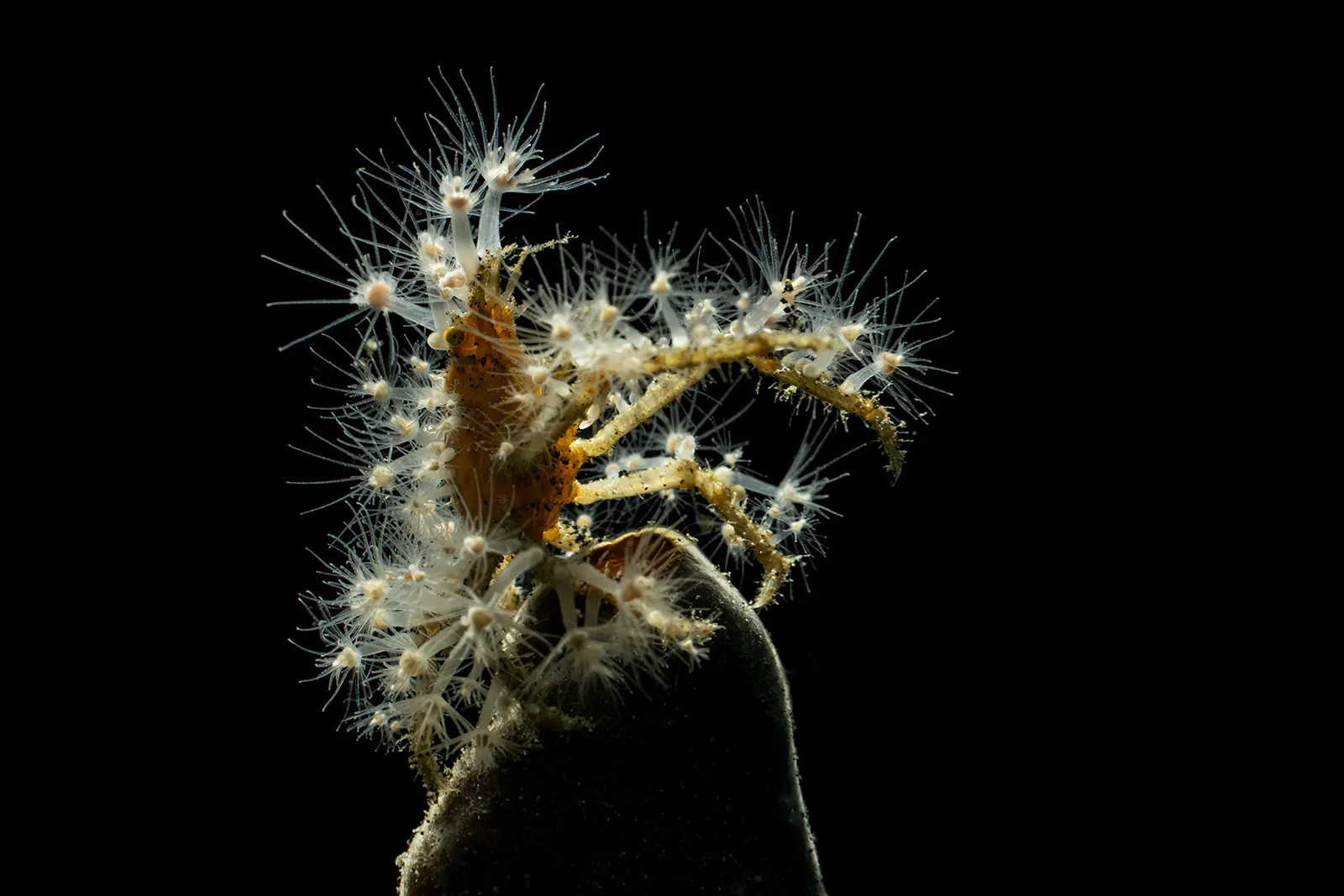
For macro photography on a Sulawesi liveaboard, time in Lembeh Strait decides the route, and published itineraries give whole-trip dive totals rather than Lembeh counts. So ask each operator how many strait dives you get. If macro is the whole point of your trip, look at a land stay beside the strait before you commit to a boat.
Why do macro photographers go to Lembeh?
They go for the animals on the sand. Lembeh Strait separates Sulawesi from Lembeh Island, with Bitung on its western side, and guides describe it as muck-diving water. Muck diving means diving on a loose sedimentary bottom, usually in relatively low visibility. In our reading, that suits a macro lens: the subject is close, the lens works through only a short column of water, and the background is plain dark sand.
Mermaid names hairy frogfish, mimic octopus, flamboyant cuttlefish and blue-ringed octopus among the strait's animals. A Lembeh resort's guide names TK, Hairball and Jahir as well-known black sand sites and notes the Banggai cardinalfish at Nudifalls. Knowing those names helps, because you can ask an operator directly whether its route stops at them.
Conditions matter for a heavy camera rig. LiveAboard.com describes the strait as sheltered and diveable all year, with roughly April to November bringing calmer conditions and better visibility. It also gives 26 to 30°C at most sites with mostly mild currents, and warns that visibility can fall to around 4 metres after heavy rain. That last figure is lower than many wide-angle shooters would accept, though much of a macro day will carry on regardless.
How many Lembeh dives do boat trips actually give?
No dive count is published for the strait. Itineraries state total dives for the whole trip, and the closest thing is Mikumba Diving's sample, which gives Lembeh days 1 to 3 or, in reverse, days 7 to 10. A boat with Lembeh in its title may spend only a small part of its time there. That one missing number should decide your route, so it is the first thing to ask. This table shows what is published.
| Trip | Length | Published dives, whole trip | Other areas named | Dives in the strait stated? |
|---|---|---|---|---|
| White Manta, Lembeh and North Manado | 8 days, 7 nights | 22 over 7 diving days | Biaro, Ruang, Siau, Mahagetang, Para, Nenung, Bangka | No |
| Explorer Ventures, Lembeh, Halmahera, Lembeh | 8 days, 7 nights | 21 to 22 | Halmahera | No |
| Mermaid, Lembeh, Togian, Lembeh, shorter version | 10 days, 9 nights | 25 | Gorontalo, Bolaang Mongondow, Togians | No |
| Wallacea Dive Cruise, Seahorse, Sorong to Bitung | 12 days, 11 nights | At least 33 | Raja Ampat, Halmahera | No |
| La Galigo, Bangka, Lembeh, Sangihe | 12 days, 11 nights | No figure on the cited page | Bangka, Sangihe | No |
| Mikumba Diving, Lembeh, Sangihe, Bangka, Bunaken, sample | 10 days, 9 nights | No figure on the cited page | Sangihe, Bangka, Bunaken | No, but it gives the strait three or four days |
The shape of a route tells you something even without a count. A trip with Lembeh at both ends of its title, such as Mermaid's or Explorer Ventures', suggests time in the strait at the start and finish. How much diving happens there is a separate question, because boarding and the last day can eat into it. A one-way crossing such as Wallacea Dive Cruise's reaches Lembeh only near its end, so a delay anywhere along the 11 nights could shorten that part.
Then there is the matter of currents. White Manta rates its trip Intermediate to Advanced with medium to strong current, which is a long way from a slow search on sand. If you plan to shoot, check whether the other sites on a route will let you use a large rig at all. Bluewater says Bangka has both sheltered reefs and exposed pinnacles where current or surge suits experienced divers. The guide to when a Lembeh boat makes sense covers route choice in more detail.
Is a land stay better for macro work?
For a trip led entirely by photography, it probably is, in our judgement. Time decides this. A base beside the strait gives you every dive day in one place, and a boat route shares those days with other regions. It also lets you return to a subject you found the day before, if your guide knows where it lives. Bluewater says one Lembeh resort has a dedicated photo centre with camera workspaces, and that facility belongs to the resort, so do not assume a boat matches it.
A boat has its own case. It suits a photographer who wants Lembeh as one chapter of a trip that takes in reefs and walls elsewhere, or who travels with a group that wants variety. Unpacking once and having meals and dives at the same address has appeal too. The comparison of liveaboard and resort goes through the wider decision. These three profiles may help:
- Macro only. Look first at a land base, and compare it with any boat that can show you a high count of strait dives.
- Macro plus reef. A boat trip touching Lembeh, or a land stay at Lembeh paired with a short trip elsewhere.
- Macro as a bonus. Ask whether a Bitung departure dives the strait at all; if it does, treat those dives as a bonus.
What about wide-angle at Bunaken?
In our reading, Bunaken is the wide-angle counterpart to Lembeh, so one camera setup may not serve both. Neptune's Bunaken guide sets them side by side: Bunaken has big scenery and clear water, while Lembeh has black sand, roughly ten-metre visibility and very small animals. The same guide says visibility around Bunaken is often 25 to 35 metres. These are one operator's descriptions, and no one has measured them officially. The comparison of Bunaken and Lembeh diving sets out how the two differ from a boat.
Check that your trip goes there at all. A "North Manado" title is no proof of it, as the routes page explains. If you want walls in your portfolio, ask for Bunaken by name and ask how many dives it gets. Bunaken's boat market looks thin in any case: LiveAboard.com lists 5 liveaboards there against 22 for Lembeh Strait, though these are listing counts rather than departures.
Plan your lens changes around dive plans. On a mixed route, tell the cruise director before each dive which lens you intend to use, and ask for the plan early, since you cannot change a port on a housed camera underwater.
What should you ask about camera facilities?
Ask each boat directly, because details like these belong to individual boats. Get answers to the points below in writing, ideally with a photo of the camera area taken on that boat.
- How many dives in Lembeh Strait does this departure plan, and at which sites?
- Is there a dedicated camera table, and how many guests share it on a full trip?
- Are there separate rinse tanks for cameras, and who else may use them?
- How many charging points are in the camera area and in cabins, and what voltage and plug type?
- How many divers does each guide take, and can a photographer pay for or request a private guide?
- Is there a limit on dive time or a fixed group return, and how does it apply to slow macro work?
- Are night dives planned in the strait, and how many?
- How do crew hand down and take back a rig, and who is responsible if it is dropped?
- How much baggage can you bring on the domestic flight to the port? Check this with the airline too.
Treat a vague reply to question 1 as useful information. An operator that has run the route should be able to give you at least a typical pattern, even if the sea or the guides change it on the day.
What do photographers ask most often?
Which Sulawesi route gives the most time in Lembeh?
None can be named from published figures, because itineraries give whole-trip dive totals and not a strait count. Ask each operator for planned dives in Lembeh on your departure, then compare those numbers directly.
Are Sulawesi liveaboards suitable for underwater photographers?
Yes, they can be, though the fit varies by boat and route. Check the camera area, the guide ratio, the dive-time rule and the currents on the route, because one published trip rates its diving Intermediate to Advanced.
Do I need a boat at all for Lembeh macro?
No. The strait can be dived from a land base, and one resort there is described as having a dedicated photo centre. A boat makes more sense when you also want other regions on the same trip.
When are conditions calmest in Lembeh?
It is diveable all year according to LiveAboard.com, with about April to November bringing calmer conditions and better visibility. It adds that visibility can fall to around 4 metres after heavy rain, so leave yourself spare dive days.
Can I shoot macro and wide-angle on one trip?
Yes, if a route reaches both, though the one trip we have read naming both, Mikumba Diving's sample, has no date on its page. Confirm that yours includes Bunaken, ask for the dive plan early, and expect to commit to one lens per dive.
Which sources support this page?
- Wikipedia: Lembeh Strait
- Wikipedia: Muck diving
- LiveAboard.com: Lembeh Strait
- LiveAboard.com: Bunaken
- Mermaid Liveaboards: Lembeh
- Mermaid: Lembeh, Togian itinerary
- Lembeh Resort: diving in North Sulawesi
- White Manta: Lembeh and North Manado trip
- Explorer Ventures: Halmahera and North Sulawesi itinerary
- Wallacea Dive Cruise: Raja Ampat, Halmahera, Lembeh, 11 nights
- La Galigo: Bangka, Lembeh and Sangihe trip
- Bluewater Dive Travel: North Sulawesi guide
- Neptune Liveaboards: Bunaken diving guide
- Mikumba Diving: Sulawesi trip information and sample itineraries
How do I reach the desk?
Send your camera setup and the itinerary you are weighing to WhatsApp +62 811-3941-4563 or bd@juaraholding.com, along with the question you most want answered.
Send the desk your region, dates, and group size. The desk replies in writing.
Ask the desk on WhatsApp bd@juaraholding.com